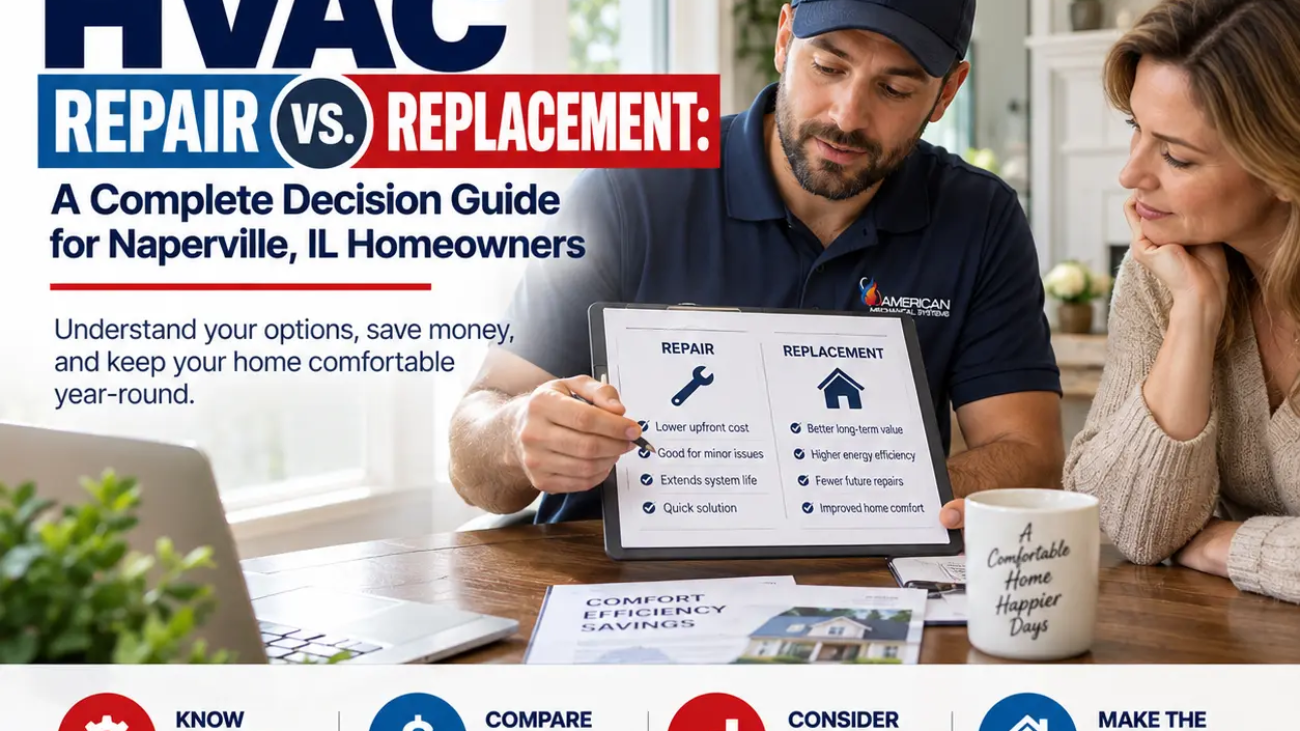
When your furnace stops heating on a January night or your air conditioner struggles through a hot, humid Naperville afternoon, one question usually comes first:
Should I repair my HVAC system or replace it?
There isn’t one age, repair price, or rule that answers that question for every home.
At American Mechanical Systems, we believe the decision should start with diagnosing what is actually wrong with the equipment—not assuming that an older system automatically needs to be replaced.
A practical HVAC repair-versus-replacement decision considers the system’s age, the failed component, repair history, current condition, refrigerant type, efficiency, comfort problems, equipment sizing and the cost of repairing the system compared with replacing it.
This guide explains those factors so homeowners in Naperville, IL and surrounding DuPage and Will County communities can make a more informed decision.
Quick Answer: Should You Repair or Replace Your HVAC System?
Repair often makes sense when:
- The system is otherwise in good condition.
- The problem involves an isolated, repairable component.
- There haven’t been repeated breakdowns.
- The repair cost is reasonable compared with replacement.
- The system still heats or cools the home effectively.
- There aren’t major airflow, humidity or comfort problems.
Replacement deserves stronger consideration when:
- The equipment is approaching or beyond its expected service life.
- Major components are failing.
- Repairs have become frequent.
- The current repair is expensive compared with replacement.
- Energy costs have increased because of declining performance.
- The system can no longer maintain comfortable temperatures.
- The equipment was improperly sized for the home.
- Refrigerant or equipment compatibility makes future repairs increasingly impractical.
The important point is that age alone shouldn’t make the decision.
An older HVAC system with a minor problem may still be worth repairing. A younger system with major recurring problems may be a better candidate for replacement.
How American Mechanical Systems Approaches Repair vs. Replacement
American Mechanical Systems takes a diagnose-first approach.
Not every service call should turn into a recommendation for new equipment.
Before deciding whether repair or replacement makes sense, the condition of the entire system should be considered—not simply the component that failed.
Important factors include:
- What actually failed?
- Can the failed component be repaired or replaced?
- What condition is the rest of the equipment in?
- How old is the system?
- How many repairs has it needed recently?
- What refrigerant does it use?
- Is the system properly sized?
- Is airflow through the home adequate?
- Does the system control temperature and humidity properly?
- How does the repair cost compare with replacement?
If repairing the existing equipment is practical and financially reasonable, repair may be the right recommendation.
If the evidence shows that a homeowner is likely to continue putting money into declining equipment, replacement deserves a serious discussion.
That’s different from replacing equipment simply because it has reached a particular birthday.
How Long Do Furnaces and Air Conditioners Last?
There is no expiration date stamped on an HVAC system.
Equipment life depends heavily on factors such as:
- installation quality,
- equipment sizing,
- maintenance,
- operating hours,
- airflow,
- filter condition,
- ductwork,
- climate,
- and previous repairs.
As equipment gets older, however, the probability of component failures generally increases.
That’s why age should be treated as one part of the decision rather than the decision itself.
For example, consider two air conditioners of the same age.
System A:
12 years old
Maintained regularly
No significant previous repairs
Cooling the house properly
Needs a relatively inexpensive electrical component
System B:
12 years old
Multiple repairs during the past two summers
Known refrigerant leak
Poor cooling performance
Increasing operating costs
They’re the same age, but they present very different repair-versus-replacement decisions.
Naperville’s Climate Matters
HVAC equipment in Northern Illinois has to handle both sides of the weather spectrum.
Naperville homes can experience hot, humid summer conditions followed only months later by prolonged periods of freezing winter temperatures.
That means the cooling system has to manage both temperature and humidity, while the heating system must be capable of handling substantial winter heating loads.
Local conditions make installation quality, equipment sizing and maintenance particularly important.
They also make it important to evaluate an HVAC system based on how it actually performs in the home, rather than relying only on its age or efficiency rating.
The 50% HVAC Repair Rule: Useful, but Not a Rule of Engineering
You’ve probably encountered the so-called 50% rule:
If an HVAC repair costs more than 50% of the price of replacement, replace the equipment.
It’s a useful financial comparison, but homeowners shouldn’t treat it as an absolute rule.
Consider a hypothetical system that costs $8,000 to replace.
A $400 repair is only 5% of replacement cost.
A $2,000 repair is 25%.
A $4,500 repair is more than half.
As the repair becomes a larger percentage of replacement cost, it becomes increasingly important to consider what you’re receiving for that investment.
But repair cost still doesn’t tell the whole story.
A relatively expensive repair on otherwise healthy equipment may make sense.
Repeated $500 and $700 repairs on deteriorating equipment can eventually become a worse financial decision than one larger repair.
That’s why repair history matters.
Why Repair History Can Matter More Than One Repair Bill
One failure doesn’t necessarily mean an HVAC system is failing.
Components wear out.
A capacitor, contactor, igniter, sensor or another serviceable component can fail while the rest of the system remains in good condition.
The situation changes when failures begin happening repeatedly.
Imagine this pattern:
June: electrical component repair
August: blower problem
Following June: refrigerant-related repair
Following August: another major component failure
Looking at each repair independently can hide the larger pattern.
That’s why homeowners should keep records of:
- service dates,
- repair costs,
- components replaced,
- refrigerant added,
- maintenance performed,
- and technician recommendations.
When several failures occur within a relatively short period, the cumulative repair cost becomes an important part of the replacement decision.
Not Every HVAC Failure Means You Need a New System
This deserves special emphasis.
A failed component does not automatically mean the entire HVAC system needs replacement.
For example, problems involving components such as capacitors, contactors, igniters, sensors and certain motors can often be repaired without replacing otherwise serviceable equipment.
Major component failures require a more careful financial evaluation.
Examples include:
- compressor problems,
- heat exchanger problems,
- significant coil failures,
- recurring refrigerant leaks,
- and major electrical or mechanical failures.
The technician still needs to evaluate the complete system.
The correct question isn’t simply:
“What broke?”
It’s:
“What broke, why did it break, and what condition is everything else in?”
The Refrigerant Question: R-22, R-410A and R-454B
Refrigerant has become one of the most misunderstood parts of the repair-versus-replacement conversation.
There are important differences between R-22, R-410A, and newer lower-global-warming-potential refrigerants used in new equipment.
Older R-22 Systems
R-22 was widely used in older residential air-conditioning systems.
Production and import of newly manufactured R-22 for servicing existing equipment ended in the United States in 2020 as part of the federal phaseout of ozone-depleting substances. Existing systems can still be serviced using available reclaimed or previously produced refrigerant, but refrigerant availability and economics can become an important consideration when an older R-22 system develops a significant leak.
For an aging R-22 system, the homeowner should consider the entire repair cost and equipment condition, rather than simply the price of replacing the leaking component.
Important 2026 Update: You Do NOT Have to Replace an R-410A System Just Because It Uses R-410A
This point is extremely important.
Federal refrigerant changes do not mean homeowners must remove functioning R-410A air conditioners or heat pumps.
The U.S. Environmental Protection Agency says existing systems can continue to be used and repaired throughout their useful lives. EPA guidance also says major components—including compressors and condensing units—may still be replaced when servicing existing systems. Components for servicing legacy R-410A equipment can continue to be sold, subject to applicable rules.
New-system refrigerant requirements and repairing an existing R-410A system are not the same thing.
Therefore:
R-410A by itself is not a reason to replace your air conditioner.
A homeowner with an R-410A system should still make the repair-versus-replacement decision based on the system’s condition, age, repair history, performance and repair economics.
Newer residential equipment is transitioning toward lower-GWP refrigerants, including refrigerants such as R-454B, but those refrigerants cannot simply be added to equipment that was designed for R-410A. EPA notes that mildly flammable refrigerants such as R-454B should not be used in systems that weren’t designed for them. Read More
Efficiency: When Operating Cost Becomes Part of the Decision
An HVAC system doesn’t have to be completely broken to be expensive.
Older equipment can continue operating while consuming considerably more energy than newer equipment or while performing below its original efficiency because of mechanical, airflow or maintenance problems.
For furnaces, efficiency is commonly expressed using AFUE — Annual Fuel Utilization Efficiency.
For modern central air conditioners and heat pumps, cooling efficiency is expressed using SEER2.
Higher efficiency can reduce energy consumption, but homeowners should be careful with claims promising a specific dollar amount of savings.
Actual savings depend on factors including:
- existing equipment efficiency,
- thermostat settings,
- weather,
- home insulation,
- windows,
- duct leakage,
- equipment sizing,
- utility rates,
- and household usage.
When considering replacement, compare actual equipment specifications and estimated operating costs, rather than relying on a generic percentage-savings claim.
Comfort Problems Can Reveal a Bigger HVAC Problem
Sometimes the equipment technically “works,” but the house still isn’t comfortable.
Common complaints include:
- upstairs bedrooms that stay hot,
- cold rooms during winter,
- large temperature differences between floors,
- weak airflow from certain registers,
- excessive summer humidity,
- frequent cycling,
- and a system that runs constantly without maintaining the thermostat setting.
These symptoms don’t automatically mean the equipment needs replacement.
The problem could involve:
- duct design,
- restricted airflow,
- insulation,
- air leakage,
- zoning,
- equipment sizing,
- or the equipment itself.
That’s why replacing the outdoor air conditioner or furnace without investigating the underlying problem can sometimes leave the homeowner with new equipment and the same comfort complaint.
Why Bigger HVAC Equipment Isn’t Necessarily Better
One of the most persistent HVAC misconceptions is that a larger furnace or air conditioner will make a home more comfortable.
That’s not necessarily true.
Oversized equipment can cycle on and off too quickly. That can affect comfort and, during cooling season, interfere with effective humidity removal.
Undersized equipment can struggle to meet the home’s heating or cooling load during demanding weather conditions.
Proper equipment sizing should be based on the home’s actual heating and cooling requirements.
The Air Conditioning Contractors of America identifies Manual J as the ANSI-recognized residential load-calculation standard. A proper load calculation considers the characteristics of the home rather than selecting equipment based solely on square footage. Read More
Why We Don’t Automatically Replace Your Old HVAC System With the Same Size
Suppose your home currently has a 3-ton air conditioner.
Does that automatically mean the replacement should also be 3 tons?
No.
The existing equipment could have been incorrectly sized when it was originally installed.
The home itself may also have changed.
For example:
- a basement may have been finished,
- an addition may have been built,
- windows may have been replaced,
- insulation may have been added,
- air sealing may have improved,
- ductwork may have changed,
- or other renovations may have affected heating and cooling loads.
That’s why replacement should involve evaluating the home’s current heating and cooling requirements, not simply reading the capacity of the old equipment and ordering another unit of the same size.
ACCA’s system-design framework separates this into several important steps: Manual J calculates residential heating and cooling loads, Manual S guides equipment selection based on those loads and manufacturer performance data, and Manual D addresses residential duct design. Read More
The American Mechanical Systems Repair-or-Replace Checklist
When evaluating an HVAC system, homeowners can organize the decision around these six areas:
| Factor | Repair May Make More Sense | Replacement Deserves More Consideration |
| Equipment condition | System otherwise tests well | Multiple components show deterioration |
| Current repair | Isolated, serviceable problem | Major or expensive failure |
| Repair history | Few previous problems | Repeated recent breakdowns |
| Performance | Home remains comfortable |
No single row automatically determines the answer.
The strongest repair or replacement recommendations are the ones where several factors point in the same direction.
Three Examples of How the Decision Works
These examples are hypothetical and are intended to show how the decision process works.
Example 1: Younger System With an Isolated Failure
A relatively young furnace develops an igniter problem.
The system has:
- no significant repair history,
- good airflow,
- normal heating performance,
- and no other known mechanical problems.
Likely direction: Repair.
Replacing an otherwise healthy furnace because of an isolated serviceable component would usually be difficult to justify.
Example 2: Older AC With a Major Repair
An older air conditioner develops a compressor problem.
The system has had one previous minor repair but has otherwise performed reasonably well.
Likely direction: Evaluate both options.
This is where the age of the equipment, compressor repair/replacement cost, refrigerant, condition of the indoor coil and other components, efficiency and replacement price should all be considered.
There isn’t enough information from “bad compressor” alone to make an honest replacement recommendation.
Example 3: Aging System With Repeated Problems
An older HVAC system has required several repairs during the previous two years and now needs another major repair.
The homeowner has also noticed declining comfort and increasing operating costs.
Likely direction: Replacement deserves serious consideration.
The important difference isn’t simply age. It’s the combination of age + repeated failures + another significant repair + declining performance.
A Simple 7-Step Repair-or-Replace Decision
Before making the decision, ask for answers to these questions:
1. What exactly failed?
Ask the technician to identify the failed component and explain the diagnosis.
2. What will the complete repair cost?
Get the repair estimate in writing when practical.
3. What condition is the rest of the system in?
A failed component on otherwise healthy equipment is different from one failure among several deteriorating components.
4. How much have I spent repairing this system recently?
Look at the previous two or three years rather than only today’s bill.
5. What refrigerant does my cooling system use?
This can affect repair options and economics, particularly with much older equipment.
6. Is the system properly heating and cooling my home?
Persistent comfort problems deserve investigation before installing replacement equipment.
7. If I replace it, how will the new equipment be sized?
Don’t assume the existing equipment capacity is automatically correct.
Repair vs. Replacement Questions Naperville Homeowners Should Ask Their HVAC Contractor
Before approving a major repair or replacement, ask:
What component actually failed?
What caused the failure?
Is the rest of the system in good condition?
How much would the repair cost?
What would comparable replacement equipment cost?
Are there other components likely to need attention soon?
What refrigerant does this system use?
Is there evidence the current equipment is improperly sized?
Are my comfort problems caused by the equipment or something else?
If you recommend replacement, how will you determine the proper equipment size?
A contractor should be able to explain why a recommendation makes sense.
HVAC Repair vs. Replacement in Naperville’s Different Types of Homes
Naperville doesn’t have one uniform housing stock.
Homes throughout areas such as Cress Creek, White Eagle, Ashbury, Tall Grass, Downtown Naperville and South Naperville differ in age, square footage, construction, additions, insulation, duct layouts and HVAC configurations.
A larger two-story home with persistent second-floor comfort problems presents a different diagnostic problem from a smaller ranch with an isolated failed capacitor.
That’s why neighborhood or square footage alone shouldn’t determine equipment size or whether replacement is necessary.
The HVAC system has to be evaluated as part of the house.
Frequently Asked Questions About HVAC Repair vs. Replacement
Is it worth repairing an older HVAC system?
It can be. Age alone doesn’t determine whether a repair is worthwhile. A minor repair on otherwise reliable equipment may still make financial sense. Age becomes more important when combined with major component failure, repeated repairs or declining performance.
Does a bad capacitor mean I need a new air conditioner?
Not by itself. A capacitor is a serviceable component. The rest of the air-conditioning system should be evaluated, but an isolated capacitor failure doesn’t automatically justify replacing the entire system.
Does a failed compressor mean I need a new AC?
Not automatically. Compressor failure is a major issue, so the technician should compare repair options with replacement while considering equipment age, refrigerant, system condition, warranty coverage and the condition of the remaining components.
Do I need to replace my R-410A air conditioner?
No—not simply because it uses R-410A. EPA says existing systems can continue to be used and repaired throughout their useful lives, including major component replacement when appropriate.
Can R-454B simply be put into my R-410A system?
No. Refrigerants are not interchangeable simply because one is newer. EPA notes that mildly flammable refrigerants such as R-454B should not be used in equipment that wasn’t designed for them.
Will replacing my HVAC system lower my utility bills?
Potentially, particularly when replacing inefficient equipment, but the amount varies significantly from house to house. Equipment efficiency, sizing, ductwork, insulation, weather, thermostat settings and utility rates all affect actual savings.
Why shouldn’t my contractor simply install the same size AC I already have?
Because the existing system may not have been sized correctly, and the home may have changed since it was installed. ACCA Manual J provides the recognized residential load-calculation methodology used to determine heating and cooling requirements.
What’s the fastest way to decide whether to repair or replace?
Start with a proper diagnosis. Then compare repair cost, overall equipment condition, repair history, system performance, refrigerant and replacement cost. Major decisions shouldn’t be based on equipment age alone.
Get a Diagnose-First HVAC Evaluation in Naperville, IL
When your heating or cooling system breaks down, you deserve to know what failed, what can be repaired and why a particular recommendation makes sense.
American Mechanical Systems provides HVAC diagnostics and repair services for homeowners throughout Naperville, IL and surrounding communities.
If the existing equipment can be reasonably repaired, we’ll explain the repair option.
If the system’s condition, repair history or economics make replacement the more practical long-term choice, we’ll explain why and discuss the available options.
Learn more about our AC repair services, furnace repair services, AC replacement and furnace installation services.
Or schedule an HVAC evaluation with American Mechanical Systems.
American Mechanical Systems
199 N Whispering Hills Dr
Naperville, IL 60540
(630) 930-7745