
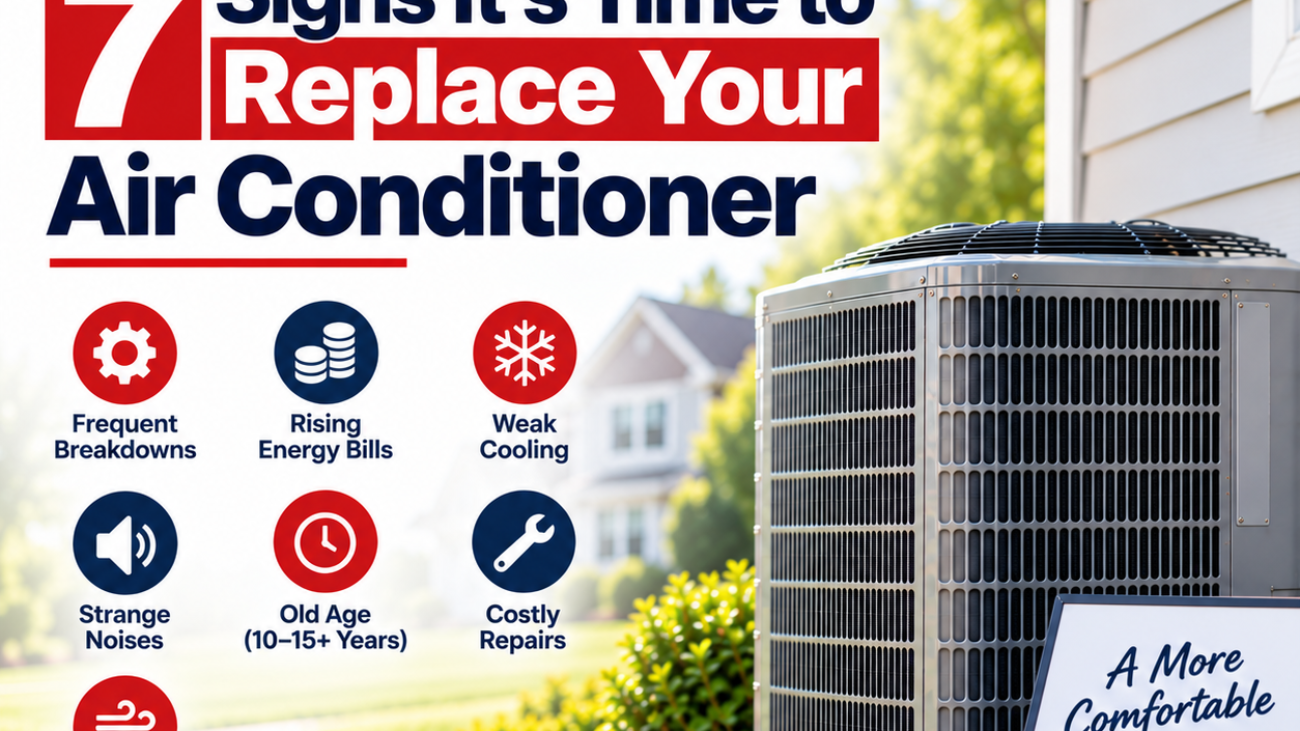
A failing air conditioner rarely stops working without giving you warning signs first. Knowing when to replace your AC can help you avoid repeated repair bills, uncomfortable summer breakdowns, and an unexpected emergency replacement.
Some AC problems can be fixed with a straightforward repair. Others indicate that the equipment is becoming unreliable or inefficient enough that replacement deserves serious consideration.
For homeowners in Naperville, Aurora, Plainfield, and surrounding Illinois communities, this guide explains the most common signs your AC needs replacement and what to consider before investing in a new system.
When Should You Replace Your Air Conditioner?
There is no single age or symptom that automatically means an AC needs to be replaced.
A better decision considers:
- Equipment age
- Repair history
- Cooling performance
- Energy consumption
- Reliability
- Repair costs
- Overall equipment condition
- Future service needs
If your system is relatively new and has one isolated problem, AC repair may be the better option.
If an older system has multiple problems and increasingly expensive repairs, AC replacement may provide better long-term value.
1. Your AC Needs Frequent Repairs
One of the clearest warning signs is a growing repair history.
If you’re repeatedly calling an HVAC technician for different problems, your system may be approaching the point where continued repairs become difficult to justify.
Frequent issues may include:
- Electrical component failures
- Refrigerant problems
- Fan motor issues
- Drainage problems
- Compressor problems
- Capacitor failures
- Thermostat issues
One repair doesn’t mean the system is finished.
But multiple repairs over a relatively short period should trigger a broader evaluation.
Ask your HVAC professional whether the current problem is isolated or whether other components are also showing signs of wear.
2. Your Air Conditioner Is Getting Older
Age is an important consideration when evaluating an AC replacement.
As equipment gets older, normal wear affects components throughout the system.
An older air conditioner may eventually become:
- Less reliable
- More expensive to repair
- Less efficient
- Noisier
- More difficult to maintain
However, an aging system isn’t automatically defective.
If an older AC continues to operate reliably and provides adequate cooling, you may decide to keep it running.
The key is to evaluate age together with condition and performance.
3. Your AC Can’t Keep Your Home Cool
If your air conditioner runs but your home still feels uncomfortable, something needs to be investigated.
Common symptoms include:
- Warm air from vents
- Long cooling cycles
- Rooms that remain hot
- Weak airflow
- Difficulty reaching the thermostat setting
- Increasing indoor humidity
These symptoms don’t automatically mean you need a new AC.
Potential causes can include:
- Dirty filters
- Ductwork problems
- Refrigerant issues
- Poor insulation
- Airflow restrictions
- Thermostat problems
- Incorrect equipment sizing
Professional diagnosis should come before making a replacement decision.
4. Your Energy Bills Keep Increasing
A noticeable increase in cooling costs can be frustrating.
However, higher electricity bills don’t automatically mean your AC is failing.
Energy use can change because of:
- Hotter weather
- Utility rate increases
- More frequent AC use
- Thermostat settings
- Changes in household occupancy
- Insulation problems
- Duct leakage
Still, if your cooling habits haven’t changed and your aging AC appears to be working harder than before, it deserves an inspection.
Declining equipment performance may contribute to higher operating costs.
5. Your AC Is Short Cycling
Short cycling occurs when an air conditioner turns on and off more frequently than it should.
This can happen for several reasons, including:
- Incorrect system sizing
- Restricted airflow
- Thermostat problems
- Refrigerant issues
- Equipment malfunction
Frequent cycling can create additional stress on system components.
If an older AC has developed persistent short-cycling problems, a professional should determine the underlying cause.
Replacing the equipment may be appropriate in some situations, but simply installing a larger AC isn’t necessarily the solution.
6. Your AC Is Making Unusual Noises
Air conditioners make some operating noise.
But a significant change in sound can indicate a problem.
Watch for:
Grinding
May indicate mechanical wear.
Screeching
Can be associated with certain motor or belt-related problems.
Rattling
May indicate loose components or debris.
Hissing
Can sometimes indicate refrigerant or airflow-related issues.
Buzzing
May be associated with electrical or component problems.
Not every unusual sound means the AC needs replacement.
Some problems can be repaired.
But if the system is older and multiple components are failing, replacement may be worth considering.
7. Your AC Breaks Down at the Worst Possible Time
An unreliable air conditioner can become especially problematic during the hottest part of summer.
If your system repeatedly fails during periods of high demand, you may find yourself paying for emergency repairs again and again.
Planning an AC replacement before complete failure can give you more control over the process.
You can research:
- Equipment options
- System size
- Efficiency
- Installation requirements
- Warranty coverage
- Contractor experience
- Project cost
Instead of waiting until your home is uncomfortable, you can make the decision on your own timeline.
Is a 10-Year-Old AC Ready for Replacement?
Not necessarily.
A system’s age is useful context, but it shouldn’t be the only factor.
A 10-year-old AC that is properly maintained and working reliably may continue operating.
Meanwhile, an older system with repeated failures may make replacement more attractive.
The important question is:
How is the system performing today, and what is its likely repair outlook?
Should You Repair an Older AC?
Sometimes, yes.
Repair may make sense when:
- The problem is minor
- Repair costs are reasonable
- The system is otherwise reliable
- Cooling performance remains good
- Major components aren’t showing significant wear
Replacement may deserve more consideration when:
- Repairs are becoming frequent
- Major components are failing
- Cooling performance is declining
- Operating costs are increasing
- The system is becoming unreliable
How Much Should You Spend on AC Repairs?
There is no universal dollar amount that automatically makes replacement the better choice.
Instead, consider the repair cost relative to:
- Equipment age
- Previous repair expenses
- Remaining expected service life
- System efficiency
- Overall condition
- Replacement cost
For example, a significant repair on a relatively new AC may be reasonable.
The same repair on an aging system with several previous failures may not provide the same value.
Don’t Replace Your AC Based on One Symptom
This is an important point.
A single problem doesn’t necessarily mean your air conditioner is finished.
For example:
Warm air → could be airflow, refrigerant, thermostat, or equipment related.
High energy bill → could be AC efficiency, weather, insulation, ductwork, or usage related.
Short cycling → could be sizing, airflow, thermostat, or equipment related.
Professional diagnosis helps identify the actual cause before you invest in replacement.
What Happens During an AC Replacement?
A professional AC replacement can involve more than simply removing one outdoor unit and installing another.
Depending on the system, the project may involve:
- Removing existing equipment
- Installing the new outdoor condenser
- Installing or connecting indoor equipment
- Refrigerant connections
- Electrical connections
- Condensate drainage
- Thermostat setup
- Ductwork evaluation
- System testing
Your contractor should explain what is included in the project before work begins.
Why AC Sizing Matters During Replacement
Don’t assume the new air conditioner should automatically have the same capacity as the old one.
Your previous system may have been:
- Oversized
- Undersized
- Correctly sized
- Installed before home renovations
- Selected using different assumptions
A professional should evaluate your home’s cooling requirements.
Important factors can include:
- Home size
- Insulation
- Windows
- Ceiling height
- Home orientation
- Ductwork
- Layout
- Local climate
Proper sizing can help support better comfort and system performance.
Should Ductwork Be Replaced With the AC?
Not automatically.
Existing ductwork may be suitable for a new air conditioner if it is:
- Properly sized
- Sealed
- Insulated
- Structurally sound
- Capable of delivering adequate airflow
However, damaged, leaking, restricted, or poorly designed ducts may require repair or modification.
If your home has persistent hot rooms or weak airflow, have the duct system evaluated before assuming a larger AC will solve the problem.
AC Replacement Can Be a Planned Investment
Waiting for complete failure isn’t the only way to replace an air conditioner.
A planned replacement can allow you to:
Compare Options
You have time to evaluate different systems.
Prepare Your Budget
You can plan for the investment instead of reacting to an emergency.
Choose Installation Timing
You aren’t necessarily forced to schedule work during peak demand.
Address Other HVAC Issues
Ductwork, thermostat, airflow, and other concerns can be evaluated as part of the project.
Questions to Ask Before Replacing Your AC
Before approving an AC replacement, ask your HVAC contractor:
1. What is wrong with my current system?
Get a clear diagnosis.
2. Is repair still reasonable?
You should understand why replacement is being recommended.
3. How was the new system size determined?
Avoid choosing equipment based solely on the old unit.
4. Will my ductwork be evaluated?
Duct problems can affect new equipment.
5. What does installation include?
Clarify equipment, labor, modifications, testing, and cleanup.
6. What warranty coverage is included?
Ask about equipment and workmanship coverage separately.
AC Replacement in Naperville, Aurora, and Surrounding Illinois
Illinois homeowners rely heavily on their air conditioners during periods of hot summer weather.
If an aging system is already showing signs of decline, waiting until the hottest day of the year can create unnecessary stress.
American Mechanical Systems provides AC repair, AC replacement, AC installation, and HVAC maintenance services for homeowners and businesses in Naperville, Aurora, Plainfield, and surrounding Illinois communities.
A professional evaluation can help determine whether your system needs a repair or whether replacement is the more practical long-term option.
Frequently Asked Questions
How do I know when to replace my AC?
Look at the combination of system age, repair frequency, cooling performance, energy use, reliability, and repair costs. Multiple warning signs together are more meaningful than one symptom.
What are the biggest signs my AC needs replacement?
Frequent repairs, declining cooling performance, increasing operating costs, major component failures, unusual noises, and unreliable operation can all indicate that replacement should be considered.
Should I replace my AC if it still works?
Not necessarily. If your system is reliable and performing well, continued operation may be reasonable. Replacement becomes more worth considering when multiple problems develop.
Is it cheaper to repair or replace an AC?
Repair usually costs less upfront, while replacement requires a larger initial investment. The better long-term option depends on the system’s age, condition, repair history, and future reliability.
Can a new AC lower my electric bill?
A newer, properly sized and installed system may operate more efficiently than an older system, but actual energy savings depend on equipment, weather, insulation, ductwork, thermostat settings, and household usage.
How long does AC replacement take?
The installation time depends on the equipment and complexity of the project. A straightforward replacement may be completed faster than a project requiring ductwork, electrical, or other modifications.
Should I replace my furnace and AC at the same time?
Not automatically. The furnace and AC should each be evaluated based on age, condition, compatibility, repair history, and expected remaining service life.
Final Thoughts
Knowing when to replace your AC can help you avoid making a major HVAC decision during an emergency.
The strongest replacement signals usually occur when several problems appear together:
Aging system + frequent repairs + declining cooling + rising costs + unreliable operation
If your AC has one isolated problem, repair may be the better choice.
If the system is increasingly unreliable and expensive to maintain, AC replacement may provide better long-term value.
For homeowners in Naperville, Aurora, Plainfield, and surrounding Illinois areas, having your system professionally evaluated can help you understand your options before the next major cooling problem occurs.