
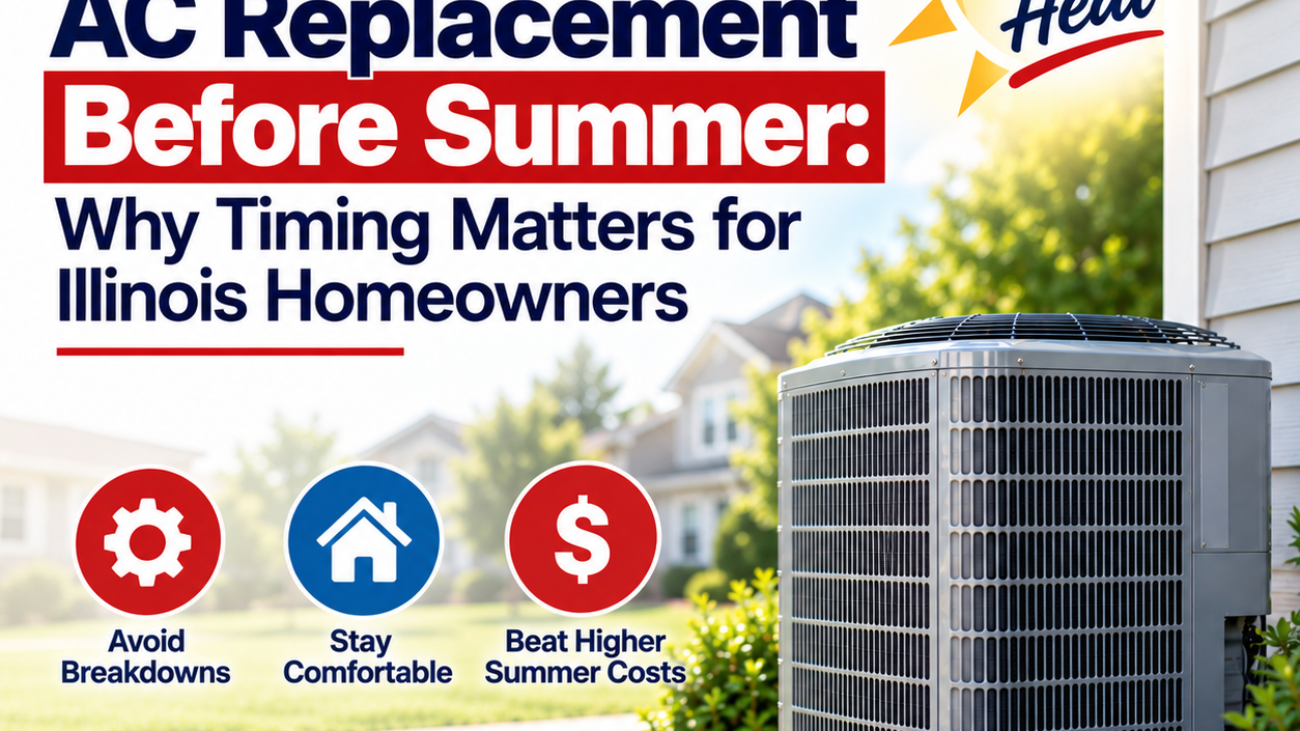
Waiting until your air conditioner completely fails can turn a planned HVAC project into an emergency. For homeowners considering AC replacement before summer, planning ahead can make it easier to evaluate equipment, compare installation options, and address potential comfort problems before the hottest weather arrives.
In Naperville, Aurora, Plainfield, and surrounding Illinois communities, air conditioning systems can face substantial demand during summer. If your current system is already showing signs of age or declining performance, spring can be a practical time to evaluate whether replacement makes sense.
Is Spring a Good Time for AC Replacement?
Spring can be an excellent time to evaluate AC replacement before the peak cooling season begins.
Replacing an air conditioner before a major breakdown can give you more time to make a thoughtful decision.
Instead of waiting for:
- No cooling during a heat wave
- Emergency service
- An unexpected repair bill
- Limited installation scheduling
- Uncomfortable indoor temperatures
you can evaluate your system while it is still operational.
However, a seasonal calendar should not be the only reason to replace an AC. The condition and performance of your current system should be the primary considerations.
1. Your AC Is Already Showing Warning Signs
If your air conditioner struggled during the previous summer, don’t ignore those symptoms.
Common warning signs include:
- Frequent repairs
- Weak airflow
- Warm air from vents
- Uneven temperatures
- Unusual noises
- Frequent cycling
- Increasing cooling costs
- Difficulty maintaining the thermostat setting
One symptom doesn’t necessarily mean you need a new AC.
But several symptoms occurring together deserve professional evaluation.
2. Avoid an Emergency AC Replacement
One of the biggest advantages of planning ahead is avoiding a last-minute decision.
When an air conditioner completely fails during extreme heat, homeowners may feel pressured to choose the fastest available solution.
Planning an AC replacement gives you time to research:
- System capacity
- Efficiency options
- Installation requirements
- Thermostat choices
- Warranty coverage
- Contractor experience
- Overall project cost
A planned replacement allows you to focus on the right system rather than simply getting the house cool again as quickly as possible.
3. An Older AC May Be Worth Evaluating
Age doesn’t automatically mean an air conditioner needs replacement.
But older equipment deserves closer attention when combined with other warning signs.
Ask yourself:
- How often has it needed repairs?
- Is it still cooling effectively?
- Are energy costs increasing?
- Is it becoming noisy?
- Has comfort become less consistent?
- Are major components beginning to fail?
If the answers raise concerns, spring can be a good time to schedule an HVAC evaluation.
4. You Have Time to Compare Replacement Options
An air conditioner isn’t something you want to choose without understanding your options.
A professional HVAC evaluation can help determine:
- Appropriate system size
- Cooling capacity
- Efficiency
- Indoor/outdoor equipment compatibility
- Ductwork requirements
- Thermostat compatibility
- Installation modifications
Don’t assume that your replacement should automatically be the same size as your existing system.
Your home’s cooling requirements may have changed.
5. Your Old AC May Not Be Properly Sized
If your current system has always struggled with comfort—or has always seemed to cycle too frequently—the problem may involve sizing.
An oversized AC can:
- Short cycle
- Provide inconsistent humidity control
- Increase mechanical cycling
- Affect comfort
An undersized AC can:
- Run for extended periods
- Struggle during extreme heat
- Have difficulty reaching the desired temperature
Professional AC sizing should consider the characteristics of your home rather than relying solely on square footage.
6. Ductwork Should Be Evaluated During Replacement
Installing a new AC doesn’t automatically fix ductwork problems.
If your home has:
- Hot bedrooms
- Weak airflow
- Uneven cooling
- Excessive dust
- Duct noises
your contractor should consider whether ductwork is contributing to the problem.
Existing ducts may be reusable if they’re properly sized, sealed, insulated, and in good condition.
In other situations, repairs or modifications may be appropriate.
7. A New AC Isn’t Just About the Outdoor Unit
Homeowners sometimes focus almost entirely on the outdoor condenser.
But an air conditioning system includes multiple components working together.
Depending on the home’s configuration, an AC installation may involve:
- Outdoor condenser
- Indoor evaporator equipment
- Air handler or furnace connection
- Refrigerant lines
- Condensate drainage
- Electrical connections
- Thermostat
- Ductwork
- Air filtration
Proper installation and system compatibility are important to overall performance.
8. Consider Comfort—not Just Energy Efficiency
Energy efficiency is important, but it shouldn’t be the only consideration.
Your replacement system should also support:
- Consistent temperatures
- Appropriate humidity control
- Adequate airflow
- Reliable operation
- Reasonable operating costs
A system that is technically efficient but poorly sized or installed may not deliver the comfort you expect.
Should You Replace Your AC If It Still Works?
Not necessarily.
A working AC doesn’t automatically need replacement.
If the system is reliable, performs well, and doesn’t have significant problems, continued operation may be reasonable.
However, replacement becomes more worth considering when the system is:
- Aging
- Frequently breaking down
- Increasingly expensive to repair
- Struggling to cool the home
- Consuming more energy
- Becoming unreliable
The goal isn’t to replace equipment unnecessarily.
The goal is to recognize when continued repairs may no longer provide good long-term value.
AC Repair or Replacement Before Summer?
If your AC is having problems, you may have two options.
Repair
Repair may make sense when:
- The system is relatively new
- The problem is isolated
- Repair costs are reasonable
- The system otherwise performs well
Replacement
Replacement may be worth considering when:
- The system is aging
- Repairs are becoming frequent
- Major components are failing
- Cooling performance is declining
- Repair costs are becoming significant
A professional diagnosis can help you compare both options.
What Should You Ask Before Replacing Your AC?
Before approving an AC replacement, ask your contractor:
“What caused my current system to fail?”
Understanding the underlying problem can help prevent repeating it.
“Is my existing system properly sized?”
Don’t automatically duplicate an old system’s capacity.
“Will you inspect my ductwork?”
Duct problems can affect the new system.
“What does the installation include?”
Clarify equipment, labor, modifications, testing, and cleanup.
“What warranty coverage is included?”
Ask about both equipment and installation/workmanship coverage.
“How will the new system be tested?”
Proper commissioning and testing help confirm that the system is operating correctly.
How to Prepare Your Home for AC Replacement
Before technicians arrive, you can make the process easier by:
Clearing the Work Area
Remove unnecessary items around the indoor and outdoor equipment.
Securing Pets
Keep pets away from the installation area.
Providing Access
Make sure technicians can access relevant equipment, electrical components, and ductwork.
Discussing Thermostat Preferences
If you’re considering a new thermostat, discuss compatibility before installation.
Asking About Maintenance
Learn what filter and maintenance requirements apply to your new system.
Does AC Replacement Improve Home Value?
HVAC equipment is an important part of a home’s infrastructure, but homeowners shouldn’t assume a specific dollar-for-dollar increase in property value from an AC replacement.
A newer system can provide practical benefits such as:
- Improved comfort
- Better reliability
- Updated controls
- Potentially improved efficiency
- Reduced likelihood of immediate equipment failure
The value depends on the property, system, installation quality, and local market.
Why Illinois Homeowners Should Plan Ahead
Illinois summers can bring periods of high cooling demand.
If an aging air conditioner fails during extreme temperatures, getting the system restored quickly can become more challenging.
Planning ahead can help you avoid making major HVAC decisions under pressure.
For homeowners in Naperville, Aurora, Plainfield, and surrounding Illinois communities, spring can be a practical opportunity to inspect an aging system and determine whether it should be repaired, maintained, or replaced before summer arrives.
Frequently Asked Questions
When is the best time to replace an AC?
There is no universal best month. Replacing an aging or unreliable system before peak cooling demand can give homeowners more time to plan and avoid an emergency failure.
Should I replace my AC before summer?
If your system is aging, frequently breaking down, or struggling to cool your home, evaluating replacement before summer can be worthwhile.
How do I know if my AC needs replacement?
Look at the combination of age, repair frequency, cooling performance, energy use, reliability, and overall condition rather than relying on one symptom.
Is it better to repair or replace an old AC?
It depends on the repair cost, system age, condition, performance, and expected future reliability. A professional HVAC evaluation can help compare both options.
Should my replacement AC be the same size as my old AC?
Not automatically. The existing system may have been incorrectly sized, or your home’s cooling requirements may have changed.
Does new AC installation require new ductwork?
No. Existing ductwork may be reused if it is properly sized, sealed, insulated, and in good condition. Some homes may require duct repairs or modifications.
Can a new AC reduce cooling costs?
A newer, properly sized and installed system may operate more efficiently than an older system, but actual energy use depends on many factors, including weather, insulation, ductwork, thermostat settings, and household usage.
What happens if my AC fails during a heat wave?
You’ll need professional diagnosis and repair or replacement. Planning ahead can reduce the risk of being forced into an emergency replacement decision during peak demand.
Final Thoughts
AC replacement before summer can be a smart planning decision when your current system is showing signs of decline.
You don’t need to replace an air conditioner simply because it has reached a certain age. But if an older system is experiencing repeated repairs, poor cooling, increasing operating costs, or unreliable operation, waiting for a complete failure may create unnecessary stress.
A professional evaluation can help you determine whether AC repair, continued maintenance, or AC replacement makes the most sense.
For homeowners in Naperville, Aurora, Plainfield, and surrounding Illinois areas, American Mechanical Systems can help evaluate your current cooling system and discuss appropriate replacement options before the summer heat arrives.