
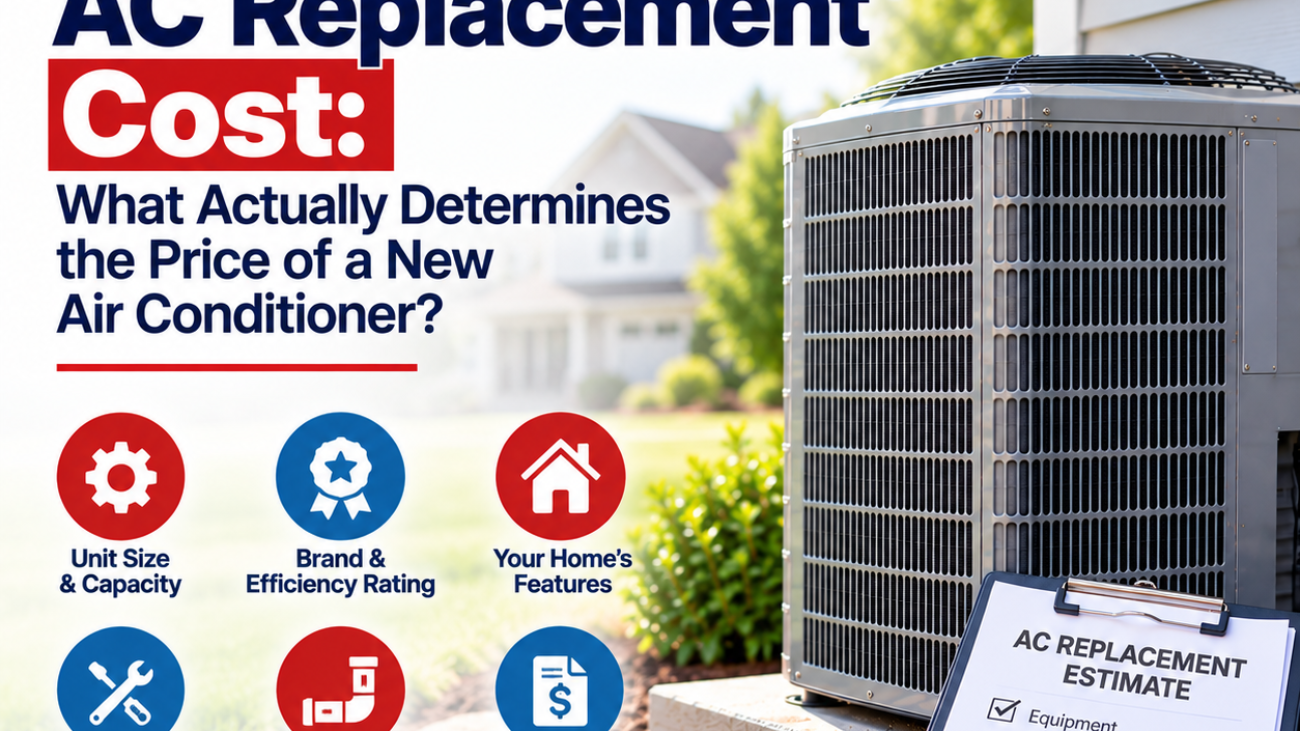
Replacing an air conditioner is a major home investment, and one of the first questions homeowners ask is: How much does AC replacement cost?
The answer isn’t the same for every home. The price of a new air conditioner depends on the equipment selected, system size, installation requirements, ductwork condition, electrical work, efficiency, labor, and other project-specific factors.
For homeowners in Naperville, Aurora, Plainfield, and surrounding Illinois communities, understanding what affects AC replacement cost can make it easier to compare estimates and avoid focusing only on the lowest upfront price.
How Much Does AC Replacement Cost?
There is no single price that accurately applies to every AC replacement project.
A professional estimate should consider the specific home and installation requirements.
The total project may depend on:
- AC system size
- Equipment efficiency
- Brand and model
- Indoor equipment
- Outdoor equipment
- Installation complexity
- Existing ductwork
- Electrical requirements
- Refrigerant line condition
- Thermostat
- Condensate drainage
- Labor
- Required modifications
This is why online AC replacement cost estimates should be treated as general information rather than a guaranteed price for your home.
What Is Included in AC Replacement?
A complete air conditioner replacement can involve much more than replacing the outdoor condenser.
Depending on the existing system, a replacement project may include:
Outdoor Condenser
The outdoor unit rejects heat from your home.
Indoor Coil or Equipment
The indoor component works with the outdoor unit to provide cooling.
Refrigerant Connections
The refrigerant circuit must be properly connected and configured.
Electrical Connections
The new equipment needs appropriate electrical connections and protection.
Condensate Drainage
Air conditioning produces condensation that needs to drain properly.
Thermostat
The existing thermostat may or may not be compatible with the new system.
System Testing
The completed system should be checked to verify proper operation.
The exact scope varies from home to home.
1. AC System Size Affects Replacement Cost
One of the biggest factors is the cooling capacity of the system.
AC capacity is commonly measured in tons.
A larger home doesn’t automatically require the largest available system, however.
Proper sizing should consider factors such as:
- Home square footage
- Insulation
- Windows
- Ceiling height
- Home orientation
- Ductwork
- Layout
- Local climate
Installing an oversized system simply because it has more capacity can create short-cycling and humidity-control problems.
2. Equipment Efficiency Can Affect the Price
Air conditioners are available with different efficiency ratings and technology levels.
Higher-efficiency equipment can have a higher upfront purchase price, but it may reduce electricity consumption depending on how the system is used and the conditions of the home.
However, higher efficiency doesn’t automatically mean better value for every homeowner.
The right choice depends on:
- Home size
- Cooling demand
- Expected usage
- Equipment cost
- Installation requirements
- Long-term ownership plans
An HVAC professional can help compare the options based on your home rather than recommending equipment solely by efficiency rating.
3. Installation Complexity Matters
Two homeowners can purchase similar equipment but have very different installation costs.
Why?
Because the homes may require different amounts of labor.
A straightforward replacement may involve removing the old equipment and installing compatible new equipment.
Another home may require:
- Electrical modifications
- Refrigerant line changes
- Drainage work
- Duct modifications
- Indoor equipment changes
- Thermostat replacement
- Additional installation labor
The more complex the installation, the more the total project can vary.
4. Ductwork Can Affect AC Replacement Cost
Your ductwork distributes conditioned air throughout the home.
If the existing duct system is:
- Properly sized
- Sealed
- Insulated
- Structurally sound
it may be possible to reuse it.
But damaged or poorly designed ductwork may require repairs or modifications.
Common ductwork concerns include:
- Air leaks
- Restricted airflow
- Poor insulation
- Damaged sections
- Improper sizing
- Uneven air distribution
A new AC cannot completely correct a major ductwork problem.
5. Electrical Work May Be Required
A new AC may have different electrical requirements than your existing equipment.
The installation may require evaluation of:
- Circuit capacity
- Disconnect
- Wiring
- Electrical connections
- Protection requirements
If modifications are necessary, they can affect the overall replacement project.
Electrical work should be handled by appropriately qualified professionals.
6. Thermostat Replacement Can Add to the Project
Your old thermostat may not provide all the features or compatibility required by the new system.
Depending on the equipment, you may consider:
- Programmable thermostats
- Smart thermostats
- Updated system controls
However, not every replacement requires a new thermostat.
Your HVAC contractor can determine whether the existing control is compatible.
7. Refrigerant Line Condition Matters
The refrigerant lines connect indoor and outdoor components.
During an AC replacement, the existing lines may be evaluated for compatibility and condition.
Potential concerns can include:
- Age
- Damage
- Contamination
- Compatibility
- Installation configuration
Whether they can be reused depends on the specific system and manufacturer’s requirements.
8. Indoor Equipment Can Affect the Project
Many homeowners focus on the outdoor condenser when thinking about AC replacement.
But the indoor coil or air-handling equipment is also important.
The indoor and outdoor components should be properly matched.
Depending on your existing HVAC configuration, replacement may involve the indoor coil, air handler, or related equipment.
This is one reason a complete system evaluation is important before receiving an AC replacement quote.
Repair vs. Replacement: Which Costs Less?
AC repair generally costs less upfront than full replacement.
But the lowest immediate cost isn’t always the lowest long-term cost.
Consider two situations.
Situation A
Your AC is relatively new and needs one straightforward repair.
Repair may be the logical choice.
Situation B
Your AC is aging and has experienced several expensive failures.
Another repair may provide only a temporary solution.
Replacement could offer better long-term value.
The right choice depends on the specific equipment and problem.
Should You Replace an AC Before It Breaks?
Not necessarily.
A functioning AC doesn’t automatically need replacement.
However, proactive replacement may be worth considering when the system has:
- Frequent breakdowns
- Increasing repair costs
- Declining cooling performance
- Increasing operating expenses
- Significant component wear
- Reliability concerns
Replacing an aging system before complete failure can also give you more time to compare installation options.
Why the Cheapest AC Replacement Estimate Isn’t Always the Best
When comparing HVAC estimates, homeowners naturally look at price.
But price should not be the only consideration.
Two proposals may have different prices because they include different:
- Equipment
- System capacities
- Efficiency levels
- Installation work
- Warranties
- Thermostats
- Duct modifications
- Electrical work
- Testing
A lower quote isn’t necessarily a better value if important installation work is excluded.
What Should an AC Replacement Estimate Include?
Before approving a project, ask for a clear written proposal.
Ideally, it should explain:
- Equipment being installed
- System capacity
- Efficiency rating
- Installation labor
- Equipment removal
- Required modifications
- Thermostat
- Warranty information
- Permits, where applicable
- Any additional charges
This makes it easier to compare estimates from different contractors.
Does a More Expensive AC Save More Money?
Not automatically.
A higher-priced system may have additional efficiency or features, but whether those benefits justify the additional upfront investment depends on your home’s needs and expected usage.
Think about the total ownership picture:
Purchase price + installation + operating costs + maintenance + expected service life
The goal is to choose a system that provides an appropriate balance between upfront cost, performance, efficiency, and reliability.
How AC Installation Quality Affects Your Investment
Equipment is only part of the replacement.
Proper installation is essential to system performance.
Installation should account for:
- Correct sizing
- Equipment compatibility
- Airflow
- Refrigerant connections
- Electrical requirements
- Drainage
- Ductwork
- Thermostat
- System testing
An expensive air conditioner won’t deliver its intended performance if installation problems prevent it from operating correctly.
How to Prepare for an AC Replacement Estimate
Before the contractor arrives, gather information about your current system.
If available, note:
- Equipment age
- Previous repair history
- Current comfort problems
- Recent energy concerns
- Rooms that stay warmer
- Unusual noises
- Frequent cycling
Also think about what you want from the replacement.
For example:
Is your priority lower operating costs?
Better temperature consistency?
Improved reliability?
Replacing an aging system before failure?
Knowing your priorities makes the consultation more productive.
8 Questions to Ask About AC Replacement Cost
1. What is included in the quoted price?
Make sure you understand exactly what you’re paying for.
2. How was the system size determined?
Avoid choosing capacity solely based on your old unit.
3. Is my ductwork suitable?
Ask whether repairs or modifications are needed.
4. What efficiency rating does the equipment have?
Understand how efficiency compares with other options.
5. Is the thermostat included?
Don’t assume every proposal includes the same controls.
6. Is equipment removal included?
Ask whether disposal of the existing system is part of the project.
7. What warranties are included?
Separate equipment warranties from workmanship coverage.
8. Are there additional potential costs?
A detailed estimate should identify known project requirements.
Can AC Replacement Lower Your Energy Bills?
It can, but there is no universal savings amount.
A newer system may operate more efficiently than an older one, especially if the existing equipment has significantly degraded.
Actual energy consumption depends on:
- New system efficiency
- Old system efficiency
- Thermostat settings
- Weather
- Insulation
- Ductwork
- Home size
- Usage patterns
- Equipment condition
A professional evaluation can help determine whether replacement is likely to improve operating efficiency.
AC Replacement for Illinois Homes
Homes in Naperville, Aurora, Plainfield, and surrounding Illinois communities can have very different HVAC requirements.
Older homes may have different ductwork and insulation characteristics from newer construction.
That means AC replacement cost in Illinois should be evaluated on a property-by-property basis.
American Mechanical Systems provides AC repair, AC replacement, AC installation, and HVAC maintenance services for local homeowners and businesses.
If your current air conditioner is aging or unreliable, a professional evaluation can help you understand your replacement options and project requirements.
Frequently Asked Questions
How much does AC replacement cost?
There is no single price for every home. Cost depends on equipment size, efficiency, installation complexity, ductwork, electrical requirements, indoor equipment, thermostat, labor, and other project-specific factors.
What is the biggest factor affecting AC replacement cost?
Equipment and installation requirements are major factors, but the total cost depends on the complete project.
Is AC replacement cheaper than repeated repairs?
It depends. A repair may be more economical for a newer, reliable system. Replacement may make more sense when an aging system requires frequent or expensive repairs.
Does a bigger AC cost more?
Larger-capacity equipment can affect equipment and installation pricing, but the system should be properly sized rather than selected based on size alone.
Does new ductwork need to be installed with a new AC?
No. Existing ductwork may be reusable if it is properly sized, sealed, insulated, and in good condition.
Can a new AC reduce energy costs?
A newer, properly sized and installed system may improve efficiency, but actual energy savings depend on many factors.
Should I get multiple AC replacement estimates?
Comparing multiple detailed proposals can help you understand equipment, installation scope, warranties, and pricing. Make sure you’re comparing similar systems and services.
Is AC replacement worth it?
It can be, particularly when an aging system has frequent repairs, declining performance, increasing operating costs, or reliability problems. The decision should be based on the complete condition of the system.
Final Thoughts
Understanding AC replacement cost is about more than finding a number online.
The final price depends on the equipment, home, installation requirements, ductwork, electrical system, efficiency, and other project details.
Before choosing a contractor, compare the entire proposal, not simply the bottom-line price.
A good AC replacement should provide the appropriate equipment for your home, proper installation, clear warranty information, and a system designed for reliable cooling.
If your air conditioner is aging, repeatedly breaking down, or struggling to keep your home comfortable, a professional evaluation can help you determine whether AC repair or AC replacement makes more sense.
For homeowners in Naperville, Aurora, Plainfield, and surrounding Illinois communities, American Mechanical Systems can help evaluate your existing system and discuss appropriate AC replacement options.