
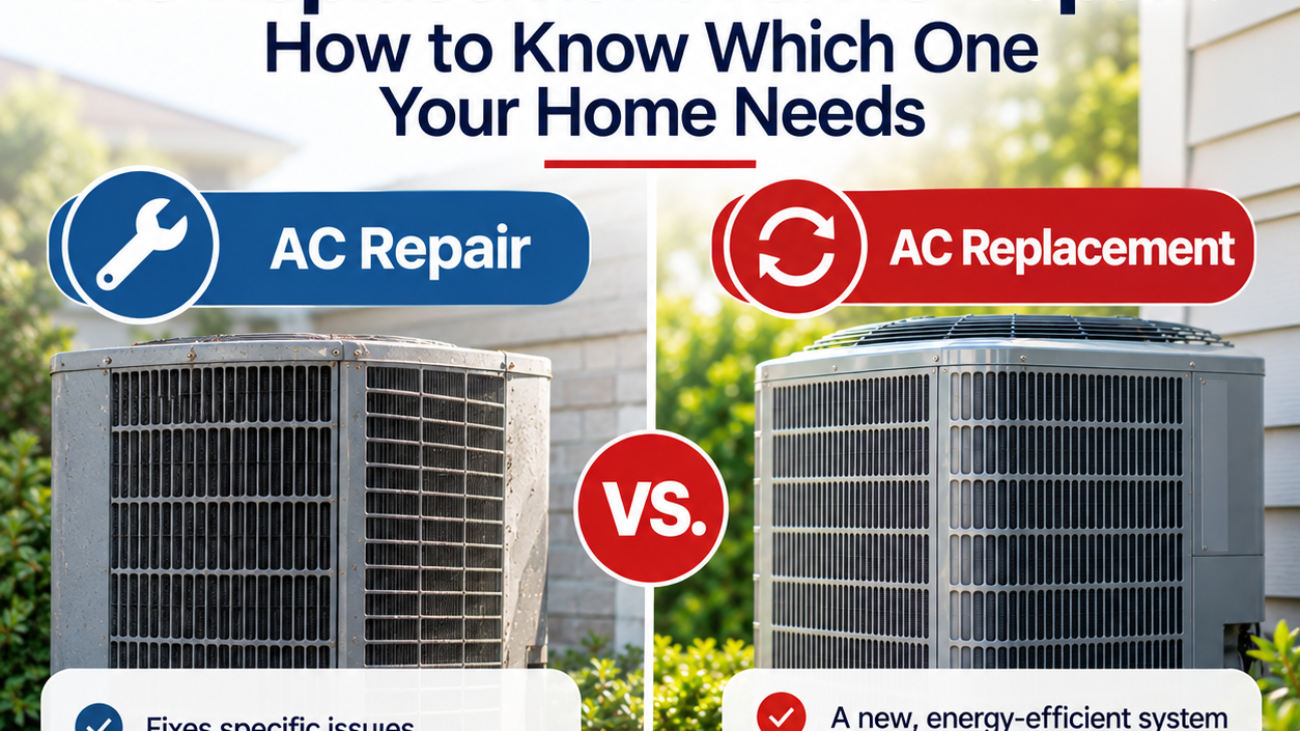
When your air conditioner stops cooling properly, the first question is often simple: Should you repair the AC or replace it?
For some homeowners, a relatively minor repair can restore reliable cooling for years. For others, continuing to repair an aging air conditioner can become more expensive than investing in a new system.
Knowing the difference between a repair-worthy AC and a system approaching the end of its useful life can help you make a more informed HVAC decision.
For homeowners in Naperville, Aurora, Plainfield, and surrounding Illinois communities, this guide explains the most important factors to consider when deciding between AC repair and AC replacement.
Should I Repair or Replace My AC?
There isn’t one answer that applies to every home.
The better decision depends on several factors, including:
- Age of the air conditioner
- Frequency of repairs
- Repair cost
- System efficiency
- Overall equipment condition
- Availability of replacement parts
- Cooling performance
- Energy consumption
- Future reliability
A relatively new AC with one isolated problem may make sense to repair.
An older system with repeated breakdowns, declining performance, and expensive repairs may be a stronger candidate for replacement.
1. How Old Is Your Air Conditioner?
Age is one of the first things to consider.
As an air conditioner gets older, components naturally experience wear.
An aging system may begin to experience:
- More frequent repairs
- Reduced cooling performance
- Higher operating costs
- Noisy operation
- Difficulty maintaining temperature
- Component failures
Age alone doesn’t automatically mean an AC needs replacement.
However, when age is combined with repeated repairs and declining performance, replacement becomes more worth considering.
2. How Often Does Your AC Need Repairs?
One repair doesn’t necessarily mean your AC is finished.
For example, a minor component failure may be reasonably repaired.
But if you’re repeatedly calling for AC repair, the pattern matters.
Frequent service calls can indicate that multiple components are reaching the end of their useful life.
Consider how often you’ve needed repairs over the past few cooling seasons.
If breakdowns are becoming a regular occurrence, compare the expected repair costs with the cost and benefits of replacing the system.
3. How Expensive Is the Repair?
Repair cost is another major consideration.
A small repair may make sense.
A major repair on an aging system deserves more careful evaluation.
Before approving an expensive repair, ask:
- How old is the system?
- What caused the failure?
- Are other components showing signs of wear?
- How much longer might the system reasonably operate?
- Would replacement provide better long-term value?
A professional diagnosis can help you understand your options without automatically assuming replacement is necessary.
4. Is Your AC Still Cooling Your Home Properly?
Performance matters just as much as age.
Your AC may technically turn on while still failing to provide adequate cooling.
Warning signs include:
- Warm air from vents
- Long cooling cycles
- Frequent cycling
- Uneven temperatures
- Weak airflow
- Poor humidity control
- Difficulty reaching the thermostat setting
If performance continues to decline despite repairs, replacement may deserve consideration.
5. Are Your Energy Bills Increasing?
A gradual increase in energy costs can have many causes.
However, an aging air conditioner may become less efficient as components wear or system performance declines.
Other factors include:
- Higher outdoor temperatures
- Changes in thermostat settings
- Increased household usage
- Insulation problems
- Duct leakage
- Utility rate changes
- Other HVAC issues
If your AC is old and your cooling costs are consistently increasing, an HVAC professional can evaluate whether equipment efficiency is contributing to the problem.
6. Is the System Breaking Down During Hot Weather?
AC failures are especially frustrating during periods of extreme heat.
If an older system repeatedly fails when cooling demand is high, consider whether another repair is the best long-term solution.
Repeated emergency repairs can become expensive and inconvenient.
Planning an AC replacement before a complete failure may give homeowners more control over:
- Equipment selection
- Installation timing
- Budget
- System efficiency
- Home comfort
When AC Repair Makes More Sense
Repair can often be a reasonable choice when:
The system is relatively young
A newer AC may have many years of potential service remaining.
The problem is isolated
If one component has failed but the rest of the system is in good condition, repair may be appropriate.
The repair cost is manageable
A modest repair may provide significantly more value than replacing the entire system.
The system still performs well
If the AC cools the home effectively and has otherwise been reliable, repair may make sense.
When AC Replacement May Make More Sense
Replacement deserves serious consideration when several warning signs occur together.
These can include:
- An aging system
- Frequent breakdowns
- Repeated expensive repairs
- Declining cooling performance
- Increasing operating costs
- Major component failures
- Persistent comfort problems
- Difficulty finding replacement components
The key is to evaluate the overall condition of the system, not just one failed part.
What Is the “50% Rule” for AC Repair?
You may have heard homeowners or contractors mention a rule suggesting that if a repair costs around half the price of a new system, replacement is automatically better.
This can be a useful starting point, but it isn’t a universal rule.
Other factors matter.
For example, a moderately expensive repair on a relatively new and well-maintained AC may still make sense.
Meanwhile, a smaller repair on a very old system that has already experienced several failures may not provide good long-term value.
Think about the total ownership outlook, not one percentage.
Why Repeated AC Repairs Can Become Expensive
Individual repairs may not seem significant.
But several repairs over a short period can add up.
For example:
Repair #1 → Repair #2 → Repair #3 → Major component failure
At some point, continuing to invest in the existing equipment may provide less value than replacing it.
This is particularly relevant when multiple major components are aging at the same time.
Read More: https://americanmechanicalsystems.com/how-often-should-you-replace-your-air-conditioner/
Should You Replace an AC Before It Completely Fails?
Not necessarily—but there can be advantages to planning ahead.
Replacing a failing system before an emergency breakdown can give you time to:
- Compare equipment options
- Research contractors
- Review installation proposals
- Plan your budget
- Schedule installation
- Avoid uncomfortable emergency conditions
If your AC is already showing multiple signs of decline, it can be useful to discuss replacement options before the system stops working completely.
What About Refrigerant Problems?
Refrigerant-related issues require professional diagnosis.
Low refrigerant isn’t simply something that should automatically be “topped off.”
A properly functioning system should not routinely lose refrigerant.
If the refrigerant level is low, the technician may need to determine whether there is a leak or another system problem.
For older equipment, homeowners may also need to consider the availability and practicality of servicing the existing refrigerant system.
The best decision depends on the equipment and the specific problem.
Can AC Repair Improve an Old System?
Sometimes.
A properly diagnosed repair can restore an aging air conditioner to working condition.
But a repair doesn’t make an old system new.
If several components are already showing significant wear, another failure may occur later.
This is why homeowners should ask about the overall condition of the system, not simply whether the current problem can be repaired.
AC Replacement Can Improve More Than Cooling
When replacement is appropriate, a new system may provide benefits beyond simply producing cold air.
Depending on the equipment and installation, homeowners may experience:
- More consistent cooling
- Improved system reliability
- Better humidity management
- Potentially improved efficiency
- Quieter operation
- Updated thermostat and control options
Actual results depend on equipment selection, installation quality, home conditions, and usage.
Don’t Ignore the Installation
If you decide that AC replacement is the right option, choosing the equipment is only part of the decision.
Installation quality matters.
The contractor should consider:
- Proper system sizing
- Indoor and outdoor equipment compatibility
- Airflow
- Ductwork
- Refrigerant connections
- Electrical requirements
- Condensate drainage
- Thermostat compatibility
- Final system testing
A high-quality air conditioner cannot perform properly if it is poorly installed.
What If Only One Component Failed?
A single component failure doesn’t automatically justify replacing the entire system.
For example, if a relatively new system has an isolated component problem, repairing it may be the most practical solution.
However, if the failed component is part of an older system that has already required multiple repairs, replacement may deserve consideration.
The right answer depends on the entire situation.
Repair vs. Replacement: A Simple Comparison
| Factor | AC Repair | AC Replacement |
|---|---|---|
| System age | Newer/medium-age | Older |
| Repair frequency | Low | High |
| Repair cost | Reasonable | Expensive/repeated |
| Cooling performance | Generally good | Declining |
| Efficiency | Acceptable | Poor or outdated |
| Reliability | Generally reliable | Frequent failures |
| Long-term outlook | Good | Uncertain |
| Upfront cost | Lower | Higher |
This isn’t a strict decision-making formula.
It is a framework for discussing your options with an HVAC professional.
7 Questions to Ask Before Choosing Repair or Replacement
Before making a decision, ask your HVAC technician:
1. What exactly failed?
Understanding the actual problem is the first step.
2. How old is my system?
Age helps put the repair into context.
3. Are other components showing wear?
A system with multiple aging components may have a higher future repair risk.
4. What is the estimated repair cost?
Get a clear understanding of the required work.
5. How has the system performed recently?
Frequent breakdowns can change the repair-versus-replacement decision.
6. Would the repair restore reliable operation?
Ask whether the repair addresses an isolated problem or a symptom of broader system deterioration.
7. What would replacement involve?
If replacement is recommended, understand equipment, installation, warranty, and expected project scope.
How Illinois Homeowners Should Think About AC Replacement
Summer weather in Illinois can place significant demand on residential air conditioning systems.
A system that is already struggling may have difficulty keeping up during the hottest periods.
For homeowners in Naperville, Aurora, Plainfield, and surrounding communities, planning ahead can be especially valuable when an older AC begins showing multiple warning signs.
Instead of waiting for a complete failure, homeowners can have the system evaluated and compare the cost of continued repairs with replacement options.
Frequently Asked Questions
Is it better to repair or replace an AC?
It depends on the system’s age, condition, repair history, repair cost, efficiency, and expected future reliability. A newer system with an isolated problem may be worth repairing, while an aging system with repeated expensive failures may justify replacement.
How do I know if my AC is too old to repair?
Age alone doesn’t determine whether repair makes sense. Consider age alongside frequent breakdowns, declining performance, expensive repairs, and overall system condition.
Is an expensive AC repair worth it?
It can be, particularly if the system is relatively new and otherwise reliable. For an older system with repeated failures, replacement may provide better long-term value.
Should I replace my AC if it still works?
Not necessarily. If the system is reliable and performing well, continued operation may be reasonable. However, if it is aging and showing multiple warning signs, planning for replacement can help avoid an unexpected failure.
How often should an AC need repairs?
There is no universal repair schedule. An air conditioner that requires frequent repairs should be professionally evaluated to determine why problems are occurring.
Can an old AC use more electricity?
An older or poorly performing system may consume more energy than a newer, properly installed system, but energy use is also affected by weather, insulation, ductwork, thermostat settings, equipment condition, and household usage.
Does AC replacement include installation?
Typically, an AC replacement project includes removing the old equipment and installing the new system, but the exact scope varies. Ask your contractor what equipment, labor, modifications, testing, and warranty coverage are included.
Can AC repair extend the life of my system?
Yes. Appropriate repairs and regular maintenance can help maintain reliable operation. However, repairs cannot eliminate normal aging or guarantee how long an older system will continue operating.
Final Thoughts
Choosing between AC repair and AC replacement isn’t simply about finding the cheapest immediate option.
Consider the bigger picture:
System age + repair history + repair cost + performance + efficiency + future reliability
A relatively new air conditioner with one repair may be a good candidate for continued service. An older system that repeatedly breaks down, struggles to cool the home, and requires increasingly expensive repairs may be approaching the point where replacement makes more sense.
If you’re unsure, a professional HVAC evaluation can help you understand the condition of your current system and compare your repair and replacement options.
For homeowners in Naperville, Aurora, Plainfield, and surrounding Illinois communities, American Mechanical Systems can help evaluate your cooling system and determine whether AC repair or AC replacement is the more appropriate next step.
[…] Read more: https://americanmechanicalsystems.com/ac-repair-vs-replacement/ […]